
Why do we need to curb our carbon emissions?
Climatic changes due to anthropogenic carbon emissions have already increased the frequency of floods, wildfires, droughts and heatwaves around the world. The last report from the IPCC published in August 2021 reminded us that there is a near-linear relation between cumulative CO2 emissions and average global temperature. Each 1000 Gt of cumulative CO2 emissions is predicted to cause an increase in global surface temperature of 0.45°C. Therefore, stabilizing human-induced global temperature increase requires reaching net zero anthropogenic CO2 emissions. In addition to CO2, other substances commonly known as greenhouse gases (GHGs) include methane (CH4), Nitrous oxide (N2O), and fluorinated gases. The IPCC (2021) report reaffirmed that human actions have the potential to avoid further emissions and remove GHGs from the atmosphere. If implemented at a scale where emissions are widely shortened and removals exceed emissions, surface temperature could be lowered with wide-ranging positive effects on climate and biogeochemical cycles, including warming reduction, increased water availability and quantity, and stable food production and biodiversity. To accomplish this, we all need to act now! Each of us can, within our own possibilities, do something to cut carbon emissions. We all could choose using bicycles or public transport over cars, trains over flights, or mind our consumption footprint over the latest fashion trend. Unfortunately, some of our activities have an unavoidable impact. Taking a flight for work commitments or visiting a relative far away, inevitably generates high amounts of GHG emissions. To offset the impact of the Inspire4Nature project, the fellows developed a project for ensuring the project is carbon neutral. First, they investigated how carbon offsetting works, then they collated data to calculate the amount of CO2 generated by our research activities, and finally they chose a project that can verifiably offset the Inspire4Nature program emissions.
Understanding carbon offsets
Carbon offsetting consists of compensating the emission of GHGs produced in one part of the world by contributing to schemes that aim to reduce these gasses elsewhere. This is possible because GHGs mix in the atmosphere, making climate change a global issue. Therefore, areas of GHG emission and reduction do not have to be the same – although it must be acknowledged that their emission can have other localized impacts such as air pollution. There are two carbon offset markets, compliance and voluntary. In the first market, companies, governments, or other entities buy offsets to comply with the GHG emission levels they have been assigned. In the voluntary market, individuals, companies or organizations, buy offsets to voluntarily mitigate their emissions, as is the case of Inspire4Nature fellows. The selection of voluntary offsetting projects is facilitated by the existence of certification programs (e.g., the Gold Standard), that provide offsetting standards and set the requirements a project needs to fulfill in order to generate certified carbon offset credits. The four main types of carbon offsetting projects are: capturing and storing or “sequestering” GHGs and preventing their release into the atmosphere (e.g., planting and maintaining forests); promoting clean and renewable energy (e.g., solar energy); capturing and destroying or transforming GHGs that would otherwise be emitted to the atmosphere (e.g., methane gas capture and converting it into electricity); and creating and participating in community projects that will help introducing energy efficient technologies in undeveloped communities.
Although carbon offsets are a useful tool to curb our GHG emissions, reducing the incidence of climate change, as well as providing environmental and social benefits, they are not without criticisms. Ensuring that an offsetting scheme really works is quite difficult, for example, a forest might need decades to offset the amount of GHG emissions it was conserved or planted for, therefore it also has to be protected from droughts, wildfires, tree diseases and deforestation. There is also the question regarding what is better, to compensate for emissions or not generate emissions at all. Nonetheless, in the current global crisis we are in, certified carbon offsets are valuable to diminish the effects of currently unavoidable GHG emissions.
Calculating emissions
The carbon calculations were done using the online tool provided by www.myclimate.org. The detailed methodology can be found at https://www.myclimate.org/information/about-myclimate/calculation-principles/. The methodology accounts for several factors responsible for carbon dioxide emissions (eg. flight distance, type of aircraft, and cargo factor, among others). The following formula was used to calculate the total CO2-equivalent emissions per passenger:
? = ?? ? +?? +? ? ∗ ??? ∗ (? −??) ∗ ?? ∗ (?? ∗ ? + ?)+ ?? ∗ ? + ?
With:
E: CO2-eq emissions per passenger [kg]
x: Flight Distance [km] which is defined as the sum of GCD, the great circle distance, and DC, a distance correction for detours and holding patterns, and inefficiencies in the air traffic control systems [km]
S: Average number of seats (total across all cabin classes)
PLF: Passenger load factor
CF: Cargo factor
CW: Cabin class weighting factor
EF: CO2 emission factor for jet fuel combustion (kerosene)
M: Multiplier accounting for potential non-CO2 effects
P: CO2 emission factor for pre production jet fuel, kerosene
AF: Aircraft factor
A: Airport infrastructure emissions
During the course of the Inspire4Nature project, the fellows, supervisors and collaborators traveled a total of 358,250 km using flights, responsible for 66.248 tonnes of CO2 and 27,751 km by surface travel (mainly train), responsible for 4963 tonnes of CO2, for a total of 71.211 tonnes of CO2.
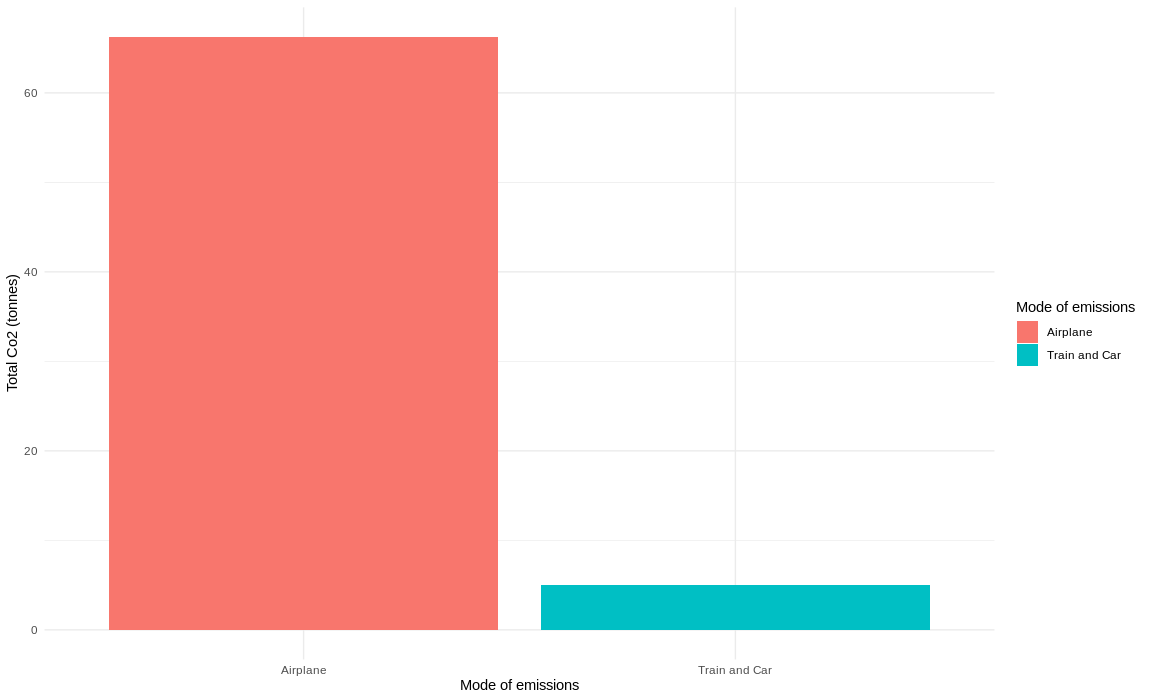
Figure 1: Summary of CO2 emissions in tons during the Inspire4Nature program.
Carbon offsetting project
To offset the carbon emissions generated by the Inspire4Nature program, the fellows chose the Envira Amazonia Tropical Forest Conservation Project. This project is reducing emissions from deforestation and degradation (REDD+) by conserving nearly 200,000 ha of tropical forest while mitigating 12.5 million tonnes of CO2 equivalent emissions over its lifetime. The project is located in Acre Brazil within the Tabocais Key Biodiversity Area (Fig. 2). Accordingly, conservation of the site will not only contribute to climate change mitigation, but also protect important native biodiversity. In addition to these benefits, the project will also improve local water quality, control erosion, and promote local livelihood sustainability through establishing alternative sources of income, formalizing land tenure, and creating social programs to facilitate agricultural production and distribution that are compatible with forest protection. Full documentation of the project can be found here.

Figure 2. Location of the Envira Amazonia REDD+ project site within Acre Brazil.
The Envira Amazonia project has been certified by both the Climate, Community, and Biodiversity Standard (CCB) and Verified Carbon Standard (VCS) which ensure that the project does contribute to avoid CO2 emissions by reducing deforestation pressure and is effective at reducing such pressure. Under the CCB certification, the project has received Triple Gold Level Distinction in recognition of its benefits not only to climate change mitigation, but also to local communities and native biodiversity.
A donation of 12 USD to the Envira Amazonia project will offset the equivalent of 1 tonne of CO2 emissions. To offset the 71 tonnes of CO2 generated by the Inspire4Nature program, a donation of 852 USD was made.
References
Bumpus, A., Liverman, D., 2008. Accumulation by decarbonization and the governance of carbon offsets. Economic Geography, 84:127-155.
IPCC, 2021: Climate Change 2021: The Physical Science Basis. Contribution of Working Group I to the Sixth Assessment Report of the Intergovernmental Panel on Climate Change [Masson-Delmotte, V., P. Zhai, A. Pirani, S.L. Connors, C. Péan, S. Berger, N. Caud, Y. Chen, L. Goldfarb, M.I. Gomis, M. Huang, K. Leitzell, E. Lonnoy, J.B.R. Matthews, T.K. Maycock, T. Waterfield, O. Yelekçi, R. Yu, and B. Zhou (eds.)]. Cambridge University Press. In Press.